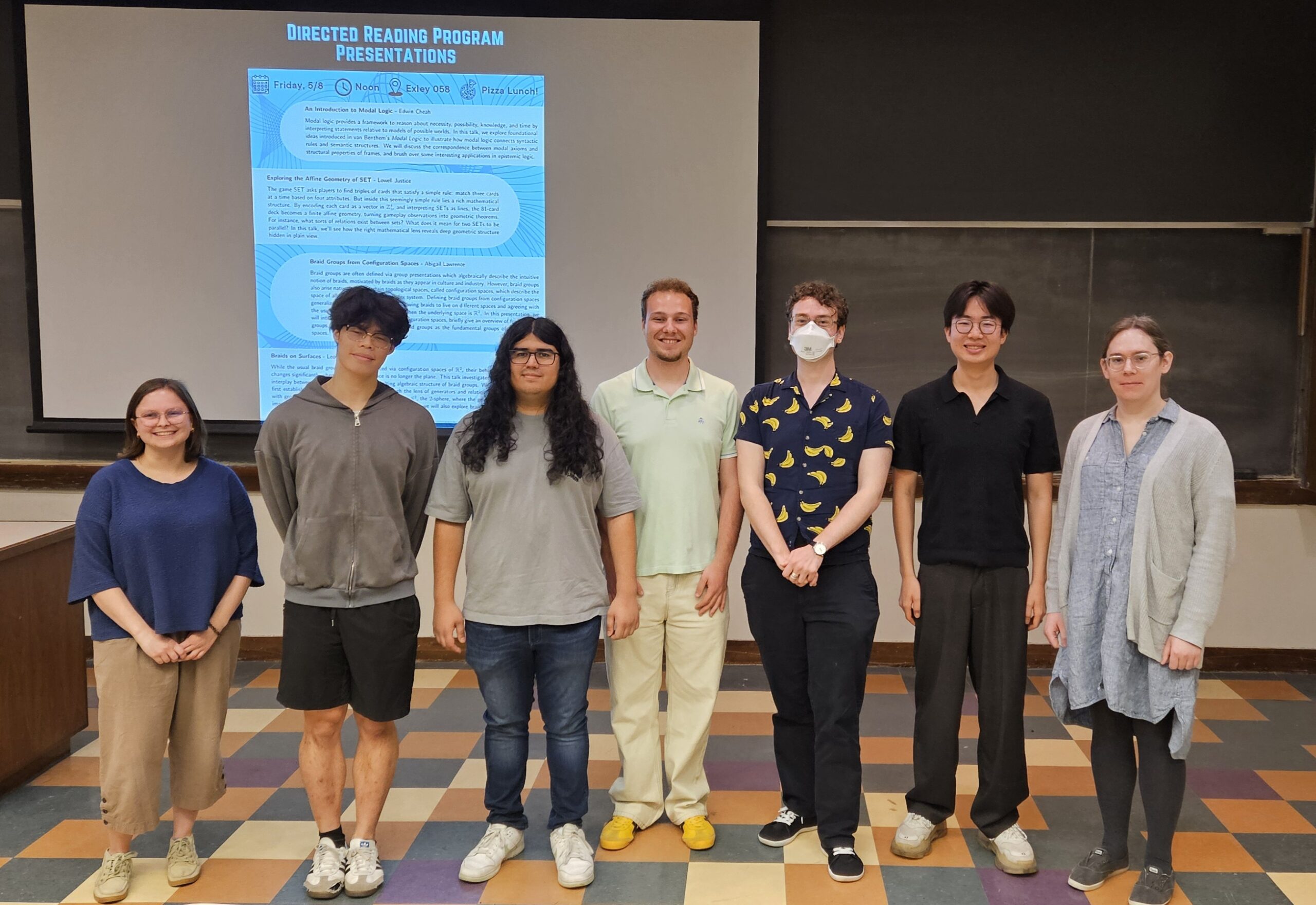
Below is a list of the DRP presentations given at the completion of the Spring 2025 semester. Click here to learn more about the DRP.
An Introduction to Modal Logic — Edwin Cheah
Abstract: Modal logic provides a framework to reason about necessity, possibility, knowledge, and time by interpreting statements relative to models of possible worlds. In this talk, we explore foundational ideas introduced in van Benthem’s Modal Logic to illustrate how modal logic connects syntactic rules and semantic structures. We will discuss the correspondence between modal axioms and structural properties of frames, and brush over some interesting applications in epistemic logic.
Exploring the Affine Geometry of SET — Lowell Justice
Abstract: The game SET asks players to find triples of cards that satisfy a simple rule: match three cards at a time based on four attributes. But inside this seemingly simple rule lies a rich mathematical structure. By encoding each card as a vector in $\mathbb{Z}_3^4$, and interpreting SETs as lines, the 81-card deck becomes a finite affine geometry, turning gameplay observations into geometric theorems. For instance, what sorts of relations exist between sets? What does it mean for two SETS to be parallel? In this talk, we’ll see how the right mathematical lens reveals deep geometric structure hidden in plain view.
Braid Groups from Configuration Spaces — Abigail Lawrence
Abstract: Braid groups are often defined via group presentations which algebraically describe the intuitive notion of braids, motivated by braids as they appear in culture and industry. However, braid groups also arise naturally from certain topological spaces, called configuration spaces, which describe the space of all possible states of a complex system. Defining braid groups from configuration spaces generalizes the idea of a braid group, allowing braids to live on different spaces and agreeing with the usual group presentation definition when the underlying space is $\mathbb{R}^2$. In this presentation, we will introduce ordered and unordered configuration spaces, briefly give an overview of fundamental groups, and discuss the definition of braid groups as the fundamental groups of configuration spaces.
Braids on Surfaces — Leo Zhang
Abstract: While the usual braid groups can be introduced via configuration spaces of $\mathbb{R}$^2, their behavior changes significantly when the underlying space is no longer the plane. This talk investigates the interplay between surface topology and the resulting algebraic structure of braid groups. We will first establish the foundations of braid groups through the lens of generators and relations, i.e. with group theory. We will then extend these concepts to $S^2$, the $2$-sphere, where the geometry imposes new relations on the braid generators. If time permits, we will also explore braid groups on the torus.